
Quick answer: Auction sheet verification means checking that the sheet you are shown is the real record from the auction house in Japan, for this exact car. You match the chassis number, compare the mileage, read the grade and the damage map, and then still get the car inspected here. A genuine sheet tells you how the car left Japan. It does not tell you what happened after that.
Most imported cars on Lahore roads, from the Vezel and Aqua to the Vitz, Prius and Mira, were sold at a dealer auction in Japan before they were shipped. Each one was checked by the auction's own inspector, who wrote down its condition on a single page. That page is the auction sheet, and it is the closest thing an imported car has to an honest first report. Auction sheet verification is how you make sure the one you are shown is genuine.
Key takeaways:
Only imported used cars have an auction sheet. A locally assembled Corolla, City or Alto never had one.
Auction sheet verification starts with the chassis number: it must match the plate on the car and the registration papers.
The grade (for example 4.5 or 3.5) is the headline, but the damage map and the inspector's notes matter more.
Mileage today should be higher than the mileage on the sheet. Lower means the odometer has been touched.
A real sheet is not a clean bill of health. Get the car inspected before you pay.
What is an auction sheet, and where does it come from?
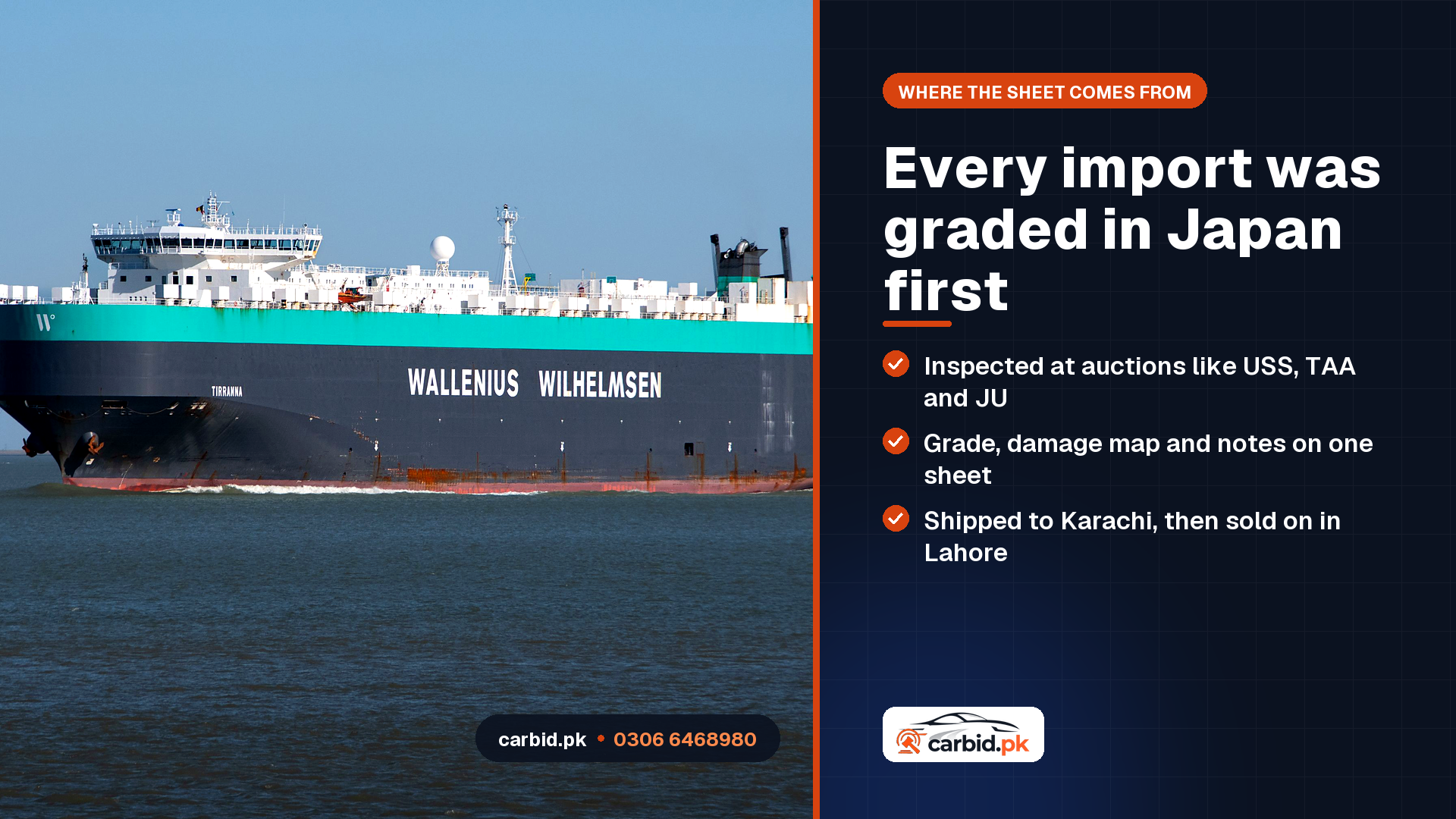
In Japan, most used cars are sold between dealers at large auction houses such as USS, TAA, JU, CAA and HAA. Before a car goes under the hammer, an inspector walks around it, drives it onto the line and fills in a sheet. Exporters buy from these auctions, ship the car to Karachi, and the sheet travels with the car's story.
The sheet is written in Japanese, mostly in short codes and a hand-drawn map of the body. It usually shows:
The car itself: model code, chassis (frame) number, year, engine size, gearbox and colour.
The mileage on the odometer on auction day.
The overall grade, plus an interior grade from A to E.
The damage map: a sketch of the car with letters and numbers on each panel.
The inspector's notes: short comments on repairs, smells, warning lights or missing parts.
Every auction house prints its own layout, so two sheets can look very different. The information on them is almost always the same.
Why the sheet matters so much when you buy in Lahore
An imported car usually lands at Karachi and then travels north. By the time it reaches a showroom on a Lahore main road or a listing online, it may have changed hands two or three times. Each sale is another chance for the story to get shorter, and the sheet is often the only record that came with the car from Japan.
Lahore adds two risks of its own. Monsoon rain floods underpasses and low streets most summers, so flood-damaged cars do come back onto the market after a clean-up. And a city this size has a busy trade in tidied-up cars, where a fresh polish and a reset odometer can hide a hard life. Our guide to Lahore's monsoon and smog season explains what water does to a car.
That is why auction sheet verification is worth doing on almost every imported car you look at in Lahore, whatever its price. It costs you a little time and it can save you from the one car you should not have bought.
Auction sheet verification: why the copy you are shown is not enough
A sheet is only useful if it is real. In the Pakistani market, buyers are often handed a printout or a phone photo, and some of those have been edited to raise the grade, remove a repair note or lower the mileage. Auction sheet verification is the step that closes that gap.
Proper verification works from the chassis number. A verification service uses it to pull the original record from the auction house's own data, so you see what the inspector actually wrote. You then compare that record, line by line, with the copy the seller gave you and with the car in front of you.
Tip: Ask for the chassis number before you travel to see the car. Get the sheet verified first. If the grade, the mileage or the repair notes change between the seller's copy and the original, you have saved yourself a wasted trip.
The five checks that matter on any sheet
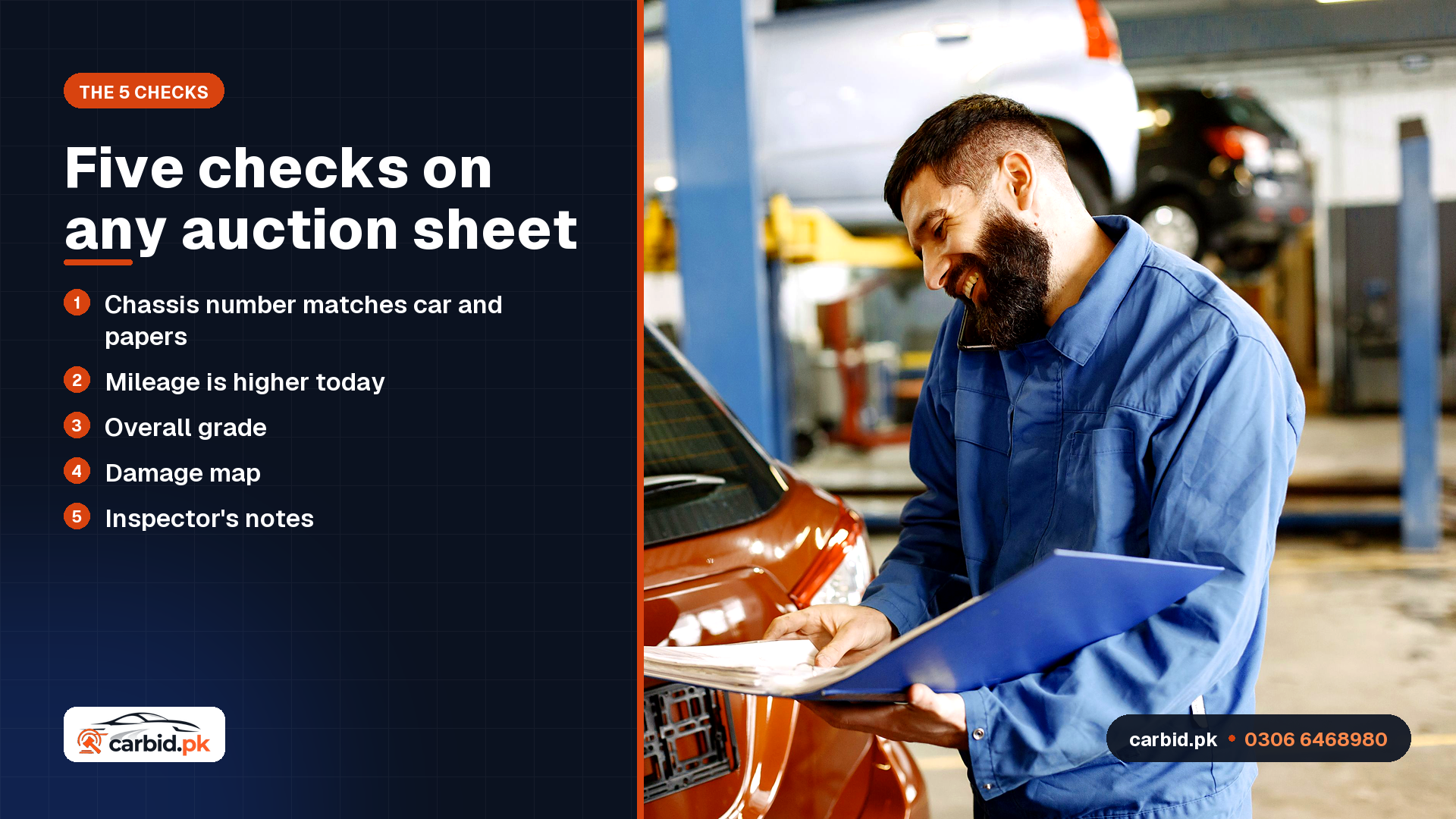
You do not need to read Japanese for auction sheet verification. Five checks cover almost everything a buyer needs.
Chassis number. It must match the plate on the car, usually stamped on the firewall or the frame, and the number in the registration book. If any one of the three is different, stop there.
Mileage. Today's odometer reading must be higher than the sheet's, by an amount that makes sense for the years since import.
Overall grade. It sets your expectations, but read it together with the map.
Damage map. It shows exactly which panels had scratches, dents, rust or repairs.
Inspector's notes. Short phrases here, such as a repaired panel, a replaced part or an engine noise, often explain a grade.
What the grades mean
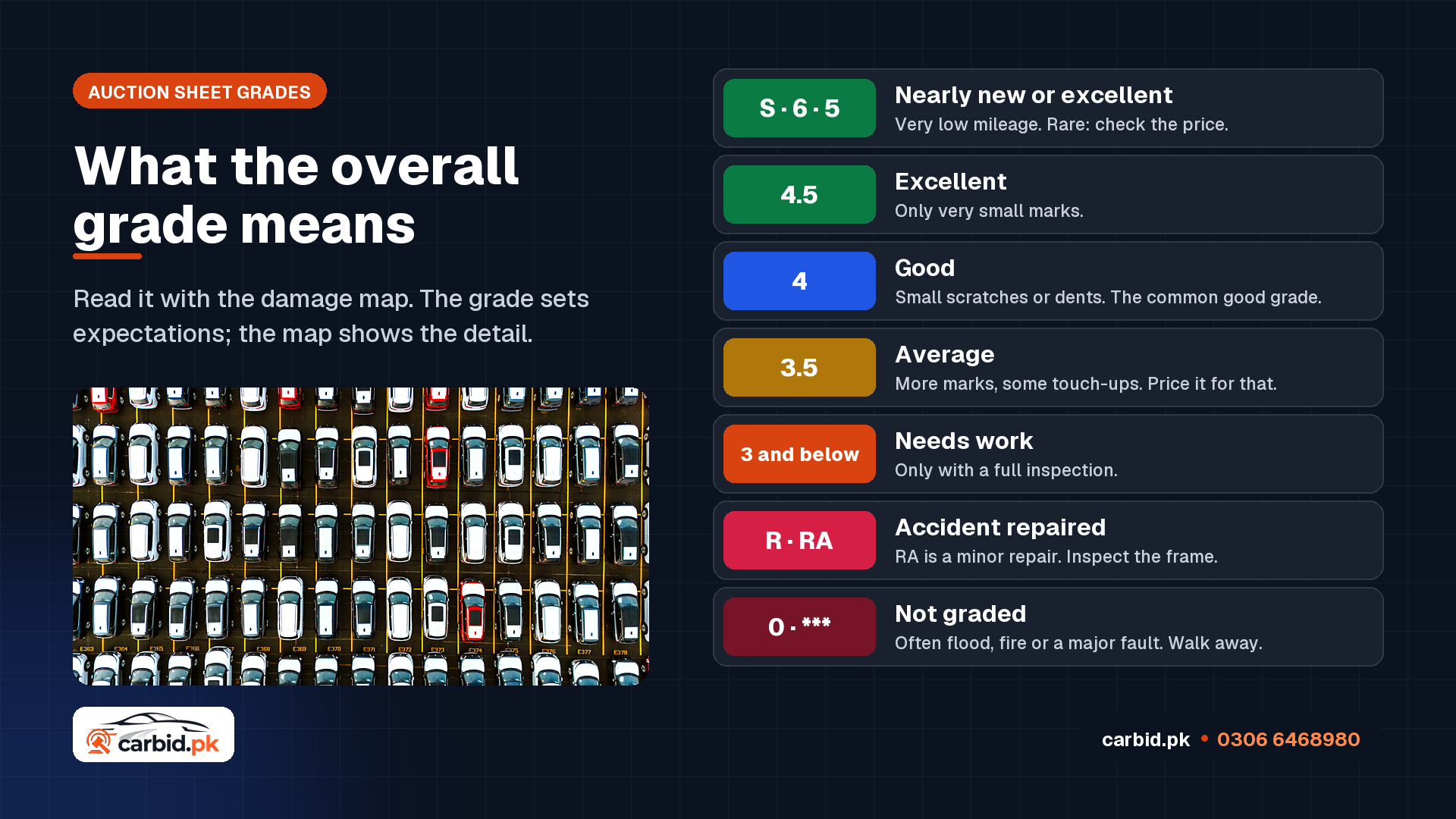
The overall grade is the number people quote first. Here is what each level usually means on a major Japanese auction sheet, and what to do about it.
Grade | What it usually means | What to do |
|---|---|---|
S or 6, 5 | Nearly new or excellent, very low mileage | Check the mileage and price closely; these are rare |
4.5 | Excellent, only very small marks | A strong buy if the papers and chassis match |
4 | Good, small scratches or dents | The most common good grade; read the map |
3.5 | Average, more marks, some touch-ups | Fine if priced for it; inspect the body |
3 and below | Below average, needs work | Only with a full inspection and a lower price |
R or RA | Repaired after an accident (RA is a minor repair) | Inspect the frame and panels; price it as repaired |
0 or *** | Not graded: often flood, fire, a major fault or sold as-is | Walk away unless you know exactly why |
The interior grade sits beside it as a letter. A is excellent, B is good, C is average with some wear, and D and E mean heavy wear, stains or damage.
Reading the damage map: letters and numbers
The map is where the real detail lives. Each mark is a letter for the type of damage and a number for its size, where 1 is small and 3 is large.
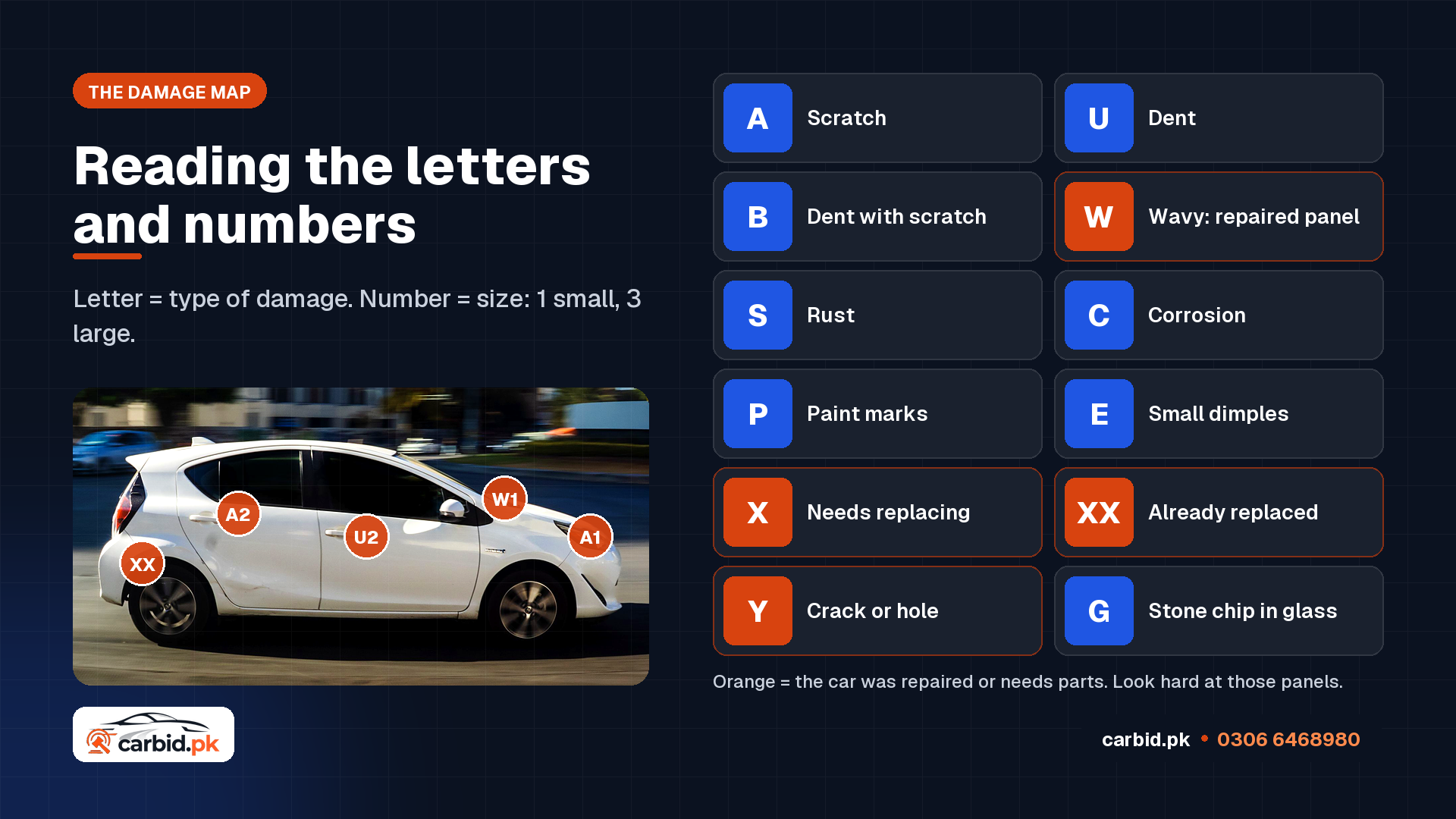
A1 to A3: scratches.
U1 to U3: dents.
B1 to B3: a dent with a scratch.
W1 to W3: a wavy panel, which usually means it was repaired and repainted.
S1 to S3: rust. C1 to C3: corrosion.
P: paint marks or faded paint. E: small dimples.
X: a part that needs replacing. XX: a part that has already been replaced.
Y: a crack or a hole. G: a stone chip in the glass.
A few A1 and U1 marks on a five-year-old car are normal wear. A W or an XX on a door, a pillar or the boot floor is different. It means the car was repaired, so look hard at that area and at the panel gaps around it. Our guide on how to spot accident and flood damage shows what to look for.
Mileage: the number that gets changed most
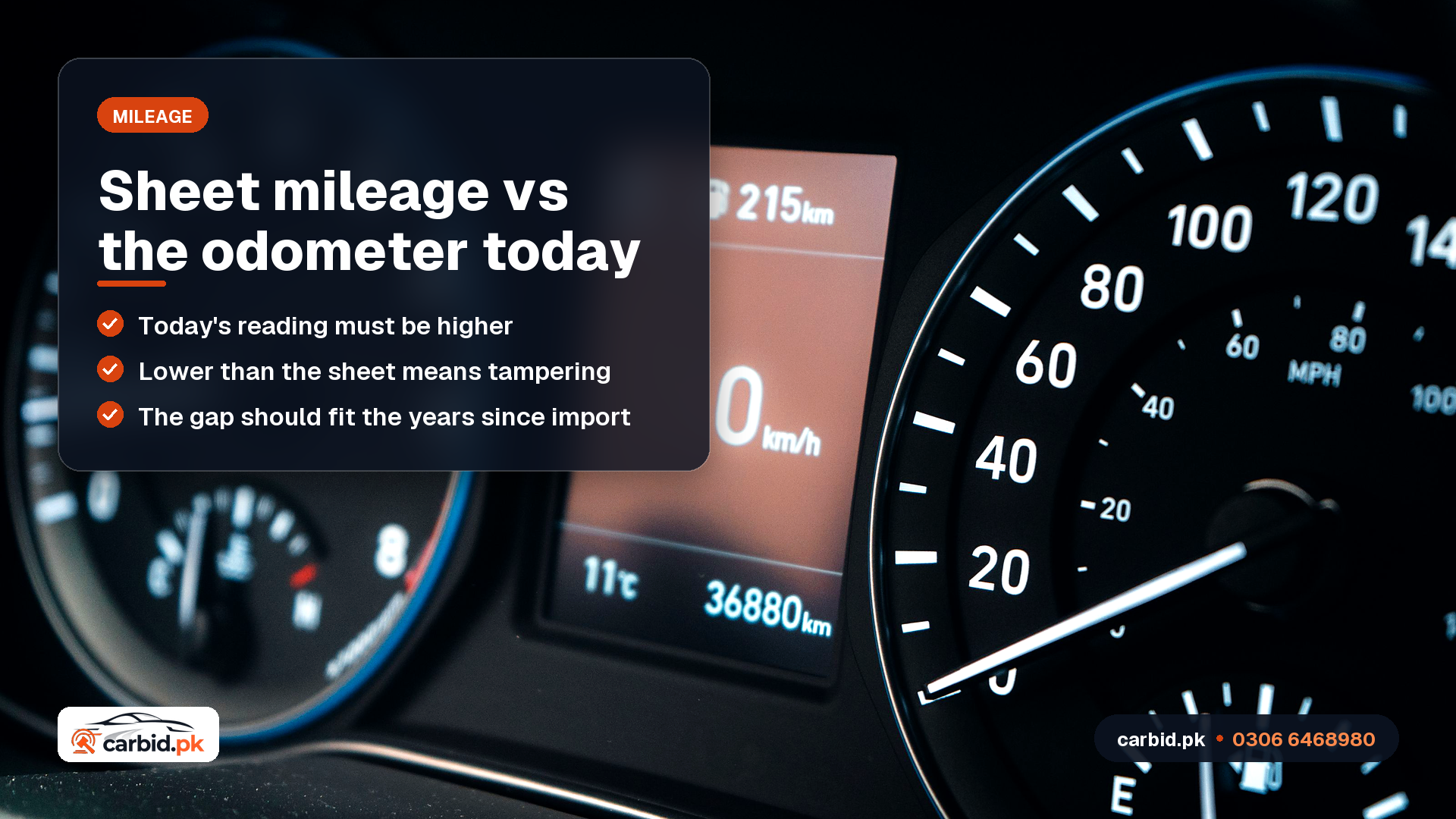
The sheet records the odometer on auction day, often only a year or two after the car was first registered in Japan. That makes it one of the few reliable mileage records an imported car has.
Compare it with the odometer now. The reading today must be higher, and the difference should fit the time the car has been in Pakistan. A Vezel that showed 40,000 km at auction and shows 35,000 km in Lahore has been tampered with. A car that has barely moved in five years of use deserves questions too. That is why mileage is the first line to compare during auction sheet verification.
What a genuine sheet cannot tell you
Even a verified sheet describes the car on one day in Japan. It says nothing about the shipping, the years on Lahore roads, a monsoon flood, a minor accident last winter or a cheap repair since then.
That is why auction sheet verification and a physical inspection do different jobs. The sheet tells you where the car started. An inspection tells you what it is like today. A proper used car inspection in Lahore checks the engine, gearbox, suspension, body and papers, and catches the damage that happened after import.
Popular imports in Lahore: what to look for on their sheets
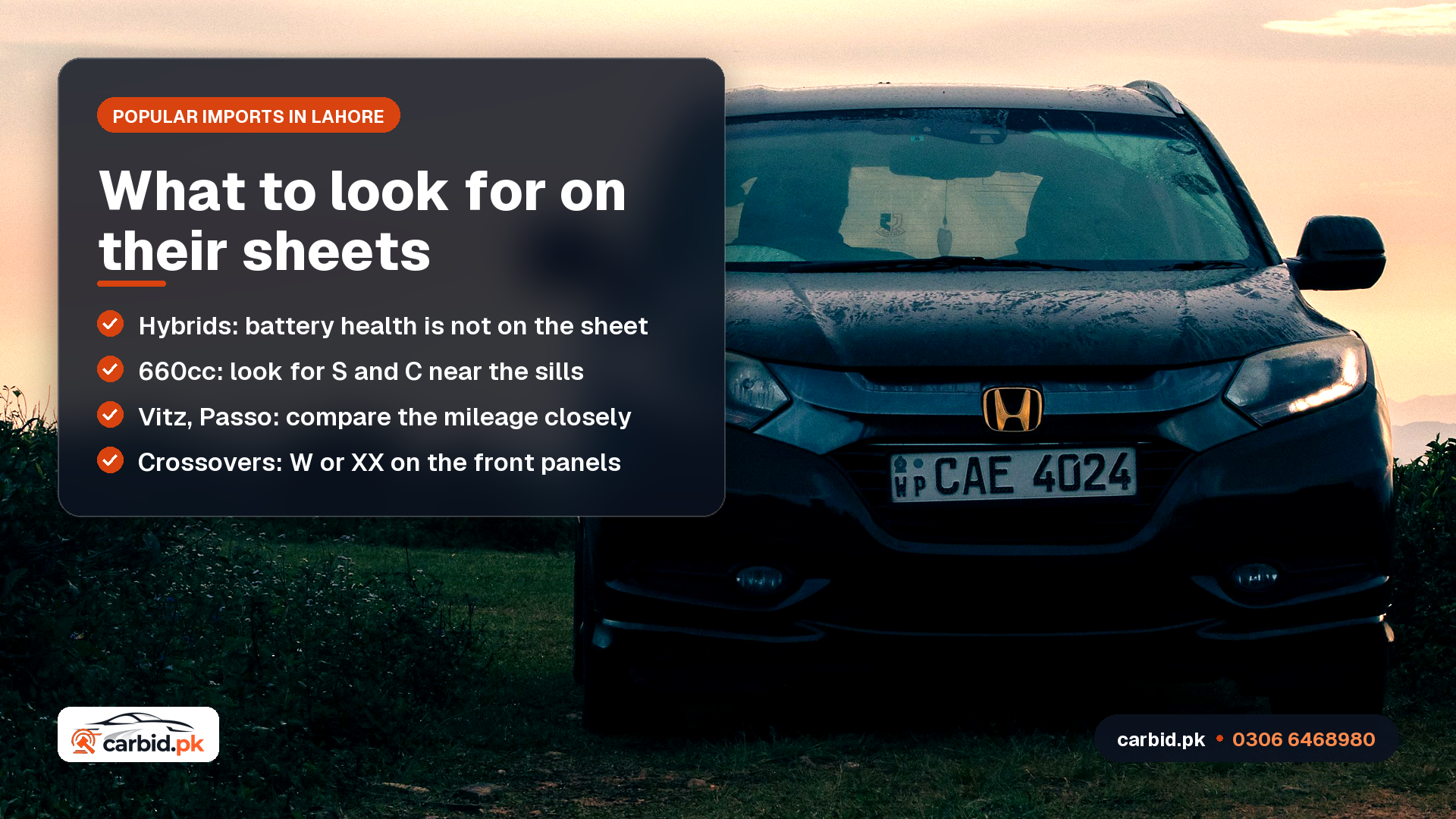
The same sheet reads a little differently depending on the car. These are the imports you will see most in Lahore, and the points worth an extra look.
Hybrids (Aqua, Prius, Vezel): the sheet records the body, mileage and grade, but it does not measure the health of the hybrid battery. Get that checked separately. Our Honda Vezel guide explains why buyers ask about it first.
660cc cars (Mira, Dayz, Move, N-WGN): small marks are normal and often keep the grade at 3.5 or 4. Look for S or C codes near the sills and the boot floor, and check the underbody in person.
Compact hatchbacks (Vitz, Passo): these are the cars where mileage matters most, because buyers pay for low readings. Compare the sheet's figure carefully.
Crossovers (Vezel, C-HR): check the map for W or XX on the front panels and bumpers, which often point to a repaired front end.
Red flags that should stop the deal
These are the warning signs that come up most often during auction sheet verification.
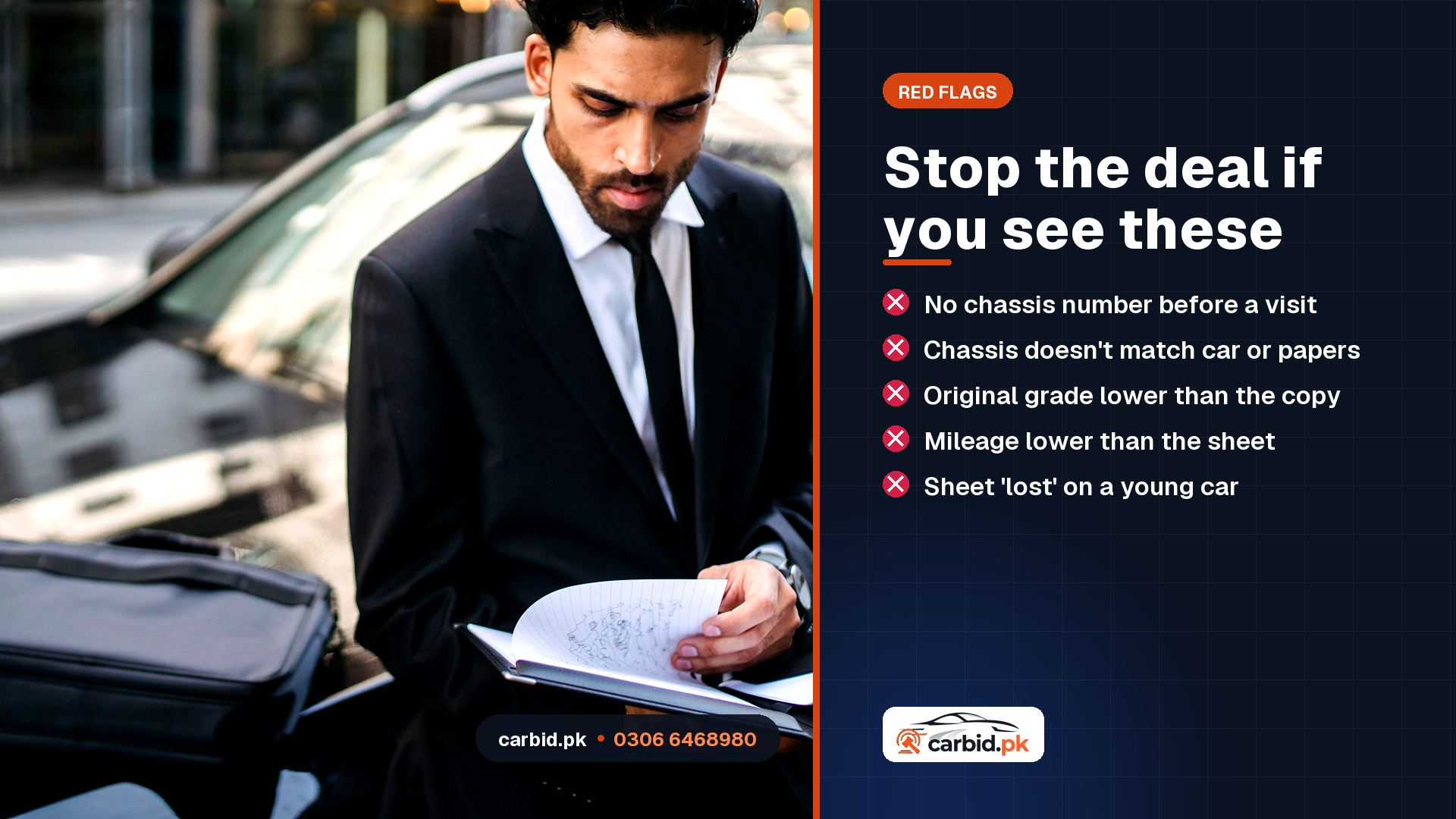
The seller will not share the chassis number before you visit.
The chassis number on the sheet does not match the car or the registration book.
The verified original shows a lower grade or more damage than the seller's copy.
Today's mileage is lower than the auction mileage.
The sheet is "lost" on a car that is only a few years old.
The grade is R, RA or 0, and nobody can explain the repair.
None of these always mean fraud. Each one means you should slow down, ask for proof and price the car for the risk.
Buying an imported car the safer way
Put it together and the order is simple when you buy an imported car in Lahore:
Before you go: ask the seller for the chassis number and a photo of the sheet on WhatsApp.
Verify: do the auction sheet verification and compare the original with the seller's copy.
At the car: see it in daylight, match the chassis plate and the registration book, and read the odometer.
Drive it: take it through real Lahore traffic, not just round the block, and listen for knocks over speed breakers.
Inspect: have the engine, gearbox, body and underbody checked before any money moves.
Transfer: finish with a proper car transfer in Lahore, so the car and its papers are in your own name.
On Carbid, cars are inspected before they are listed, and the 135-point report is published on the listing. A car that has not been inspected says so plainly. If you are buying at auction, our guide to car auctions in Lahore explains how bidding, the refundable deposit and the inspection report work. For the wider checklist, see how to buy a used car in Lahore.
Frequently asked questions
Q1. Is a 4.5 grade car accident-free?
A1. Usually, yes, at the time of the auction. A 4.5 grade means only very small marks. It does not cover anything that happened after the car left Japan, so the car still needs an inspection.
Q2. Can an auction sheet be fake?
A2. Yes. Edited copies do turn up, which is why auction sheet verification uses the chassis number to pull the original record. Always compare the original with the copy you were given.
Q3. Do locally assembled cars have an auction sheet?
A3. No. Only used cars imported from Japanese auctions have one. For a local car, the service record, the registration papers and an inspection do the same job.
Q4. What if the seller says the sheet is lost?
A4. The original can usually still be found from the chassis number, as long as the car went through a major auction. If the record cannot be found at all, treat the car as having no history and price it that way.
Q5. Does an inspection replace the auction sheet?
A5. No, you need both. The sheet shows the car's condition and mileage in Japan. The inspection shows its condition today, after shipping and years of driving here.
Q6. Is auction sheet verification worth it on a cheap 660cc car?
A6. Yes. A cheap car with a hidden flood or accident history is still an expensive mistake. The check takes little time, and on a small car it is often the only history you will get.
Looking for an imported car you can trust? Browse inspected cars for sale or join a live auction. Questions before you go and see a car? Call or WhatsApp us on 0306 6468980.